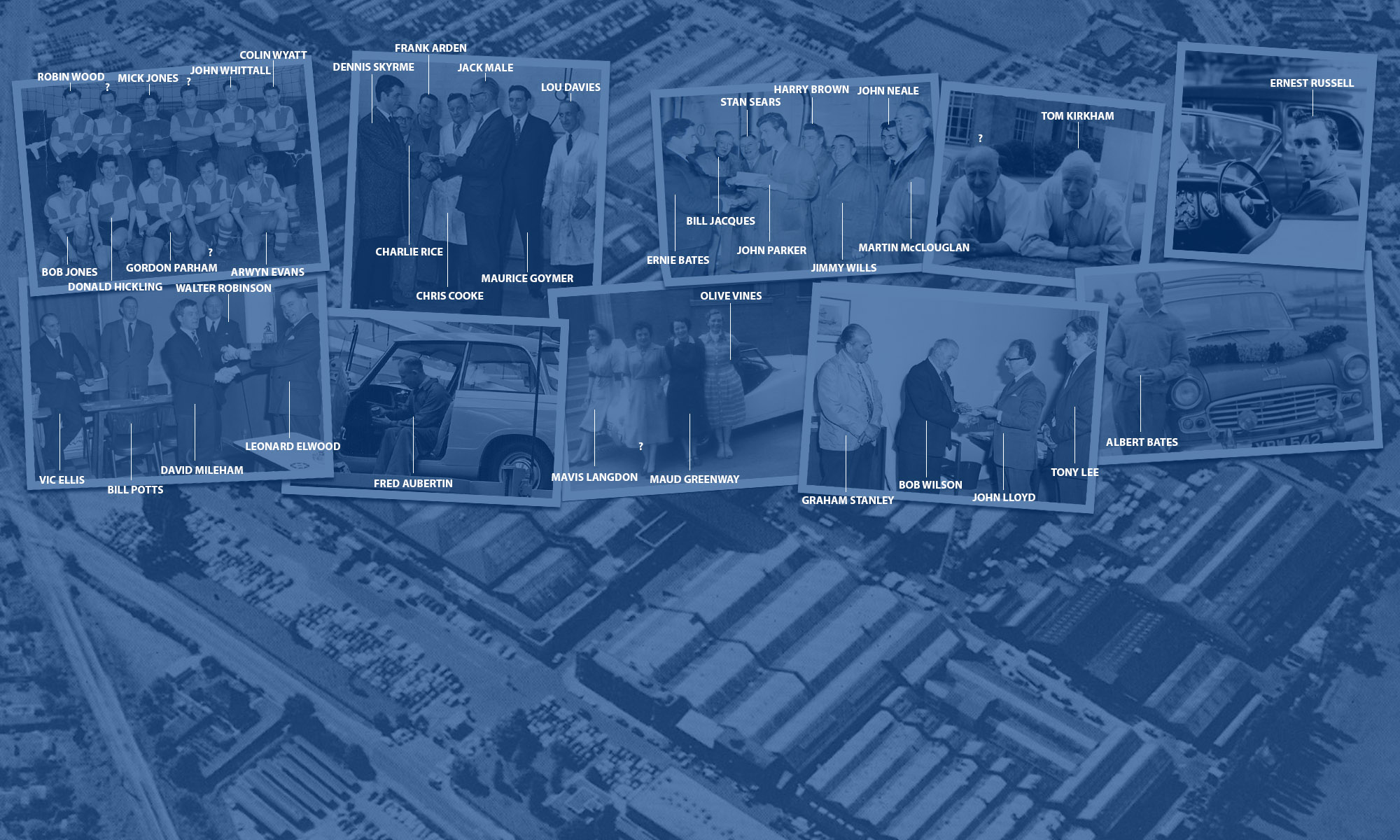
17 Shop Tinsmith Welders presentation to Pete Davis by Mr Ball, the foreman to Pete Davis on his forthcoming wedding on October 25th 1969. Continue reading “Pete Davis – Tinsmith Welders 17 Shop”
Donald Healey
Born 3rd July 1898, died 13th January 1988. Works rally driver, Experimental Manager 1934-1939, and General Manager 1940 under Thos Ward’s ownership. Responsible for the Triumph Southern Cross and straight-eight Triumph Dolomite. Famed “Healey” car marque. Joined Triumph in 1933. Continue reading “Donald Healey”
Activity at Allesley
The launching of the Triumph Herald in April was followed in succeeding months by its presentation in the capitals of Europe. In addition, all the other models in the Standard Triumph range had to be prepared for display in the company’s stands at motor shows on the continent.
Earls Court demanded the biggest effort of all, and Service Manager Mr A.G. Brown and his team at Allesley worked against the clock up to the evening of Sunday October 18, 1959 preparing the cars for the show, which was opened to the Press only two days later.
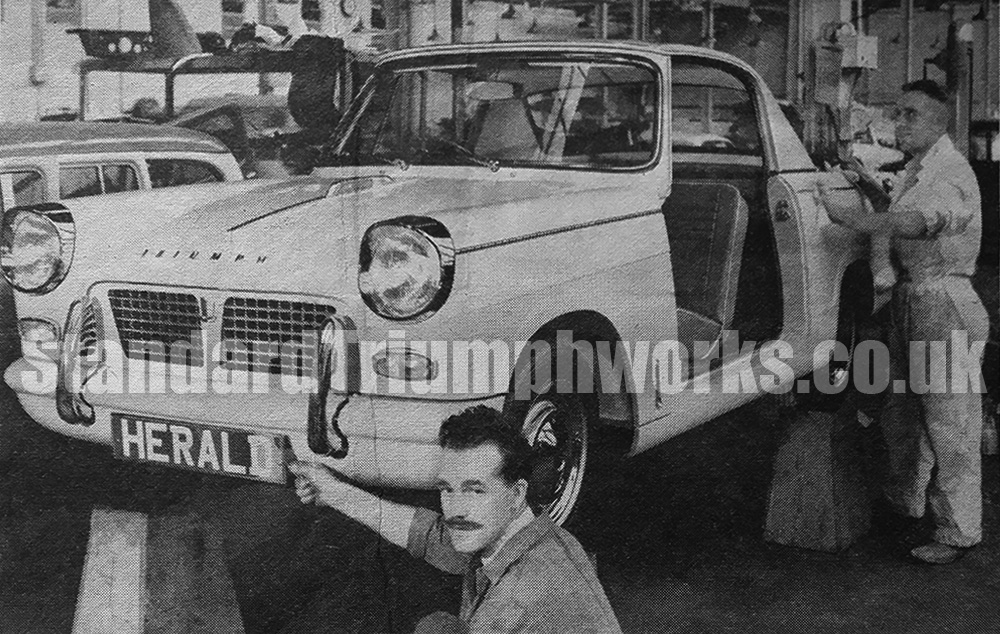
They handled 17 cars for Earls Court, three the the Berkeley Square showrooms and eight demonstration models, including a Herald Saloon in the latest colours of Signal Red and White. The cars for London showrooms and one for Berkeley Square were prepared – for the first time – by the London Service Division.
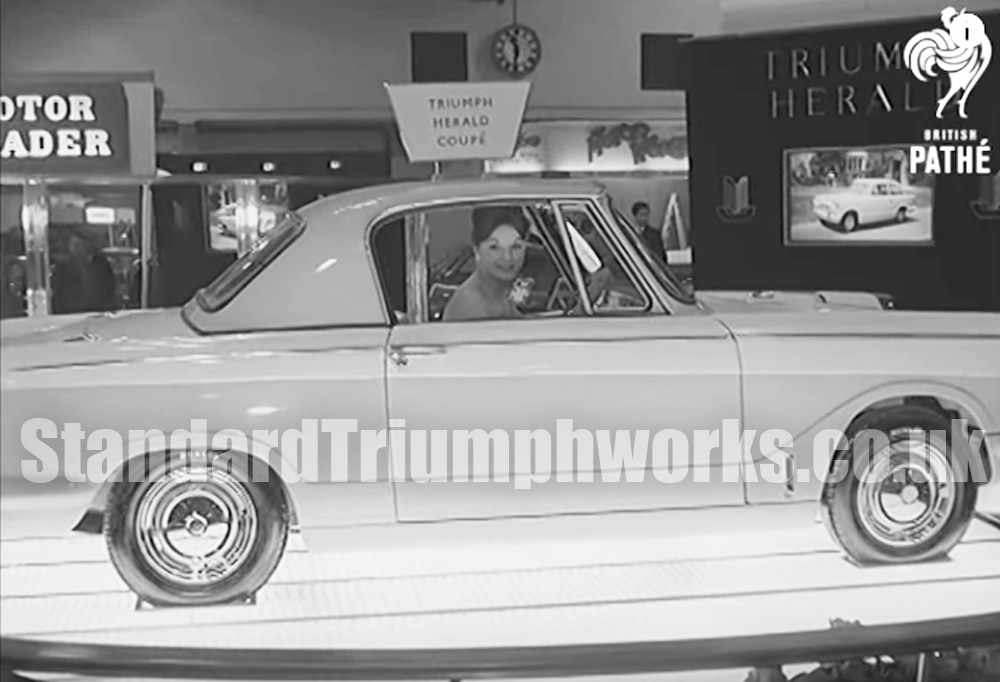
With all the cars all ready in their protective coverings, the Transport Department came into the picture for Phase 2 of the operation – successfully completed by Mr J.H. Holbrook’s* drivers, who delivered their precious cargo unmarked to the exhibition hall.
Meanwhile the Service Department had prepared and sent off six cars for the Turin Show and were getting 23 cars and commercial vehicles ready for the Scottish Motor Show.
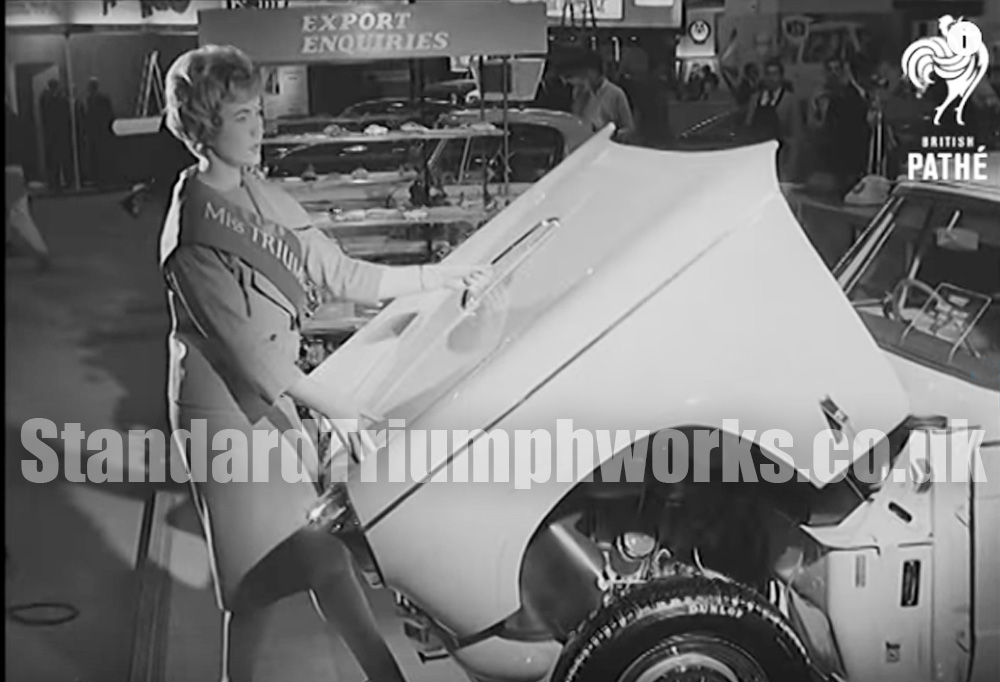
Altogether, the Service Department prepared 117 cars and commercial vehicles for the shows in 1959, together with 29 vehicles for Press demonstrations – a total of 146.
*J H Holbrook – Jim. Transport Manager with 46 years Service. Retired 1972. MORE…
Pete Davis – Tinsmith Welders 17 Shop Pt2
A second photo has been sent through thanks to Pete Davis, again Tinsmiths, around 1970. Continue reading “Pete Davis – Tinsmith Welders 17 Shop Pt2”
Home Guard
As an apprentice toolmaker, Thomas Cumberlidge was considered a far too valuable commodity to have his life put at risk in the regular army.
Continue reading “Home Guard”
Mosquito Makers
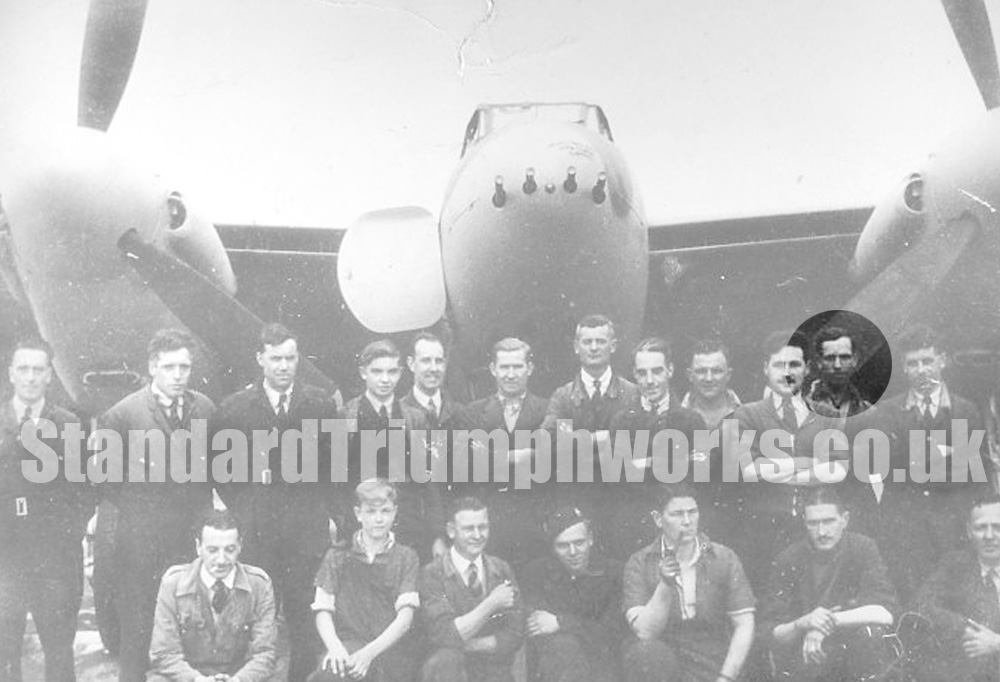
The photograph showing a group of workers in front of a de Havilland Mosquito was taken at the Standard Motors Facility at Ansty. Standard Motors were contracted to produce Mosquitos and Airspeed Oxford Aircraft during WW2. The original photo, and more details about the Mosquito, can be seen HERE.
Component manufacture, sub assembly and main assembly was carried out at the Standard Factory in Coventry. The wings and fuselage were then transported on low loaders to Ansty, where final assembly and flight testing was carried out. The Ansty Facility had previously been owned and used by Air Service Training, a subsidiary of Armstrong Siddeley Motors. The site was returned to the care of ASM after the war, and still exists as Rolls-Royce plc. The buildings occupied by Standard are still in use. The photograph was probably taken to mark a milestone in production. Possibly the 500th, the 1,000th or maybe the 1,066th, which was the total produced by Standard. The aircraft shown is an FBMk.VI.
Details by Ron Frost
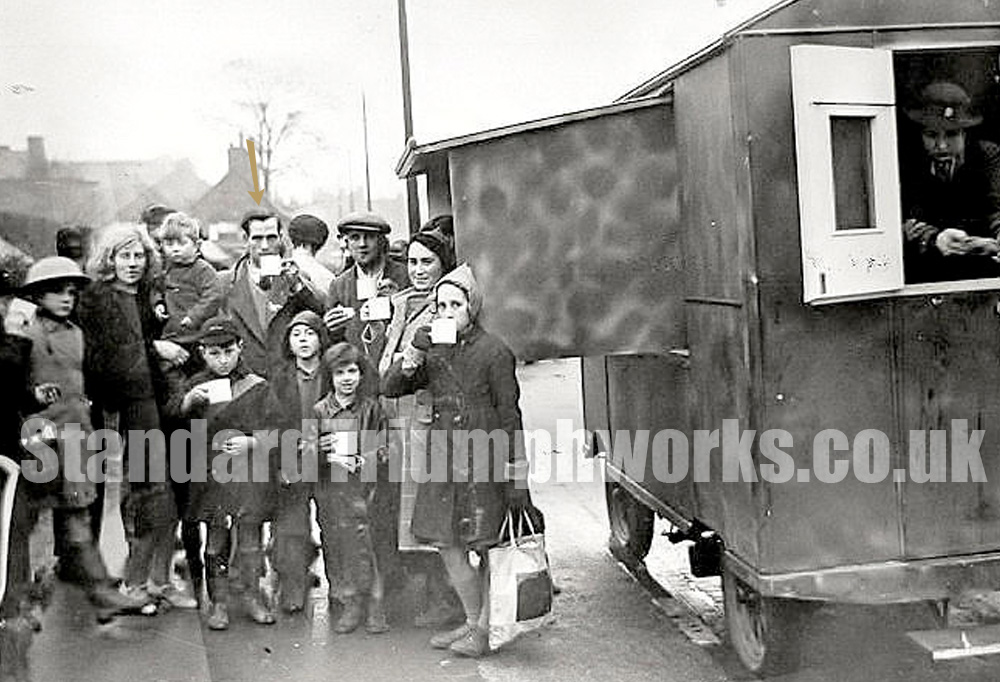
In both images (above) we now have a postive identification of Alf Hitchin, who worked at the Standard works. On the second photo, dated immediately after the Coventry Blitz, Alf can be seen enjoying a cup of tea from a mobile tea wagon.
Another worker has also been identified. Fifth from left (on top photo) is Bill Wanley…
Back row, fifth from left and standing under the aircraft door is Bill Wanley, Test Pilot. Bill had never ever flown before being trained by the RAF to fly the Mosquito. My late uncle told me that one lunchtime Bill flew one just above the railway line at Canley and virtually ‘jumped’ over the Fletchamstead Bridge – just to show the workers what they had built.
After the war Bill went back to car production and eventually became the manager of the Quality Control Department at the Fletch South factory. One would have thought he would have made a career of flying; when I was an apprentice he once told me that he had never flown since!
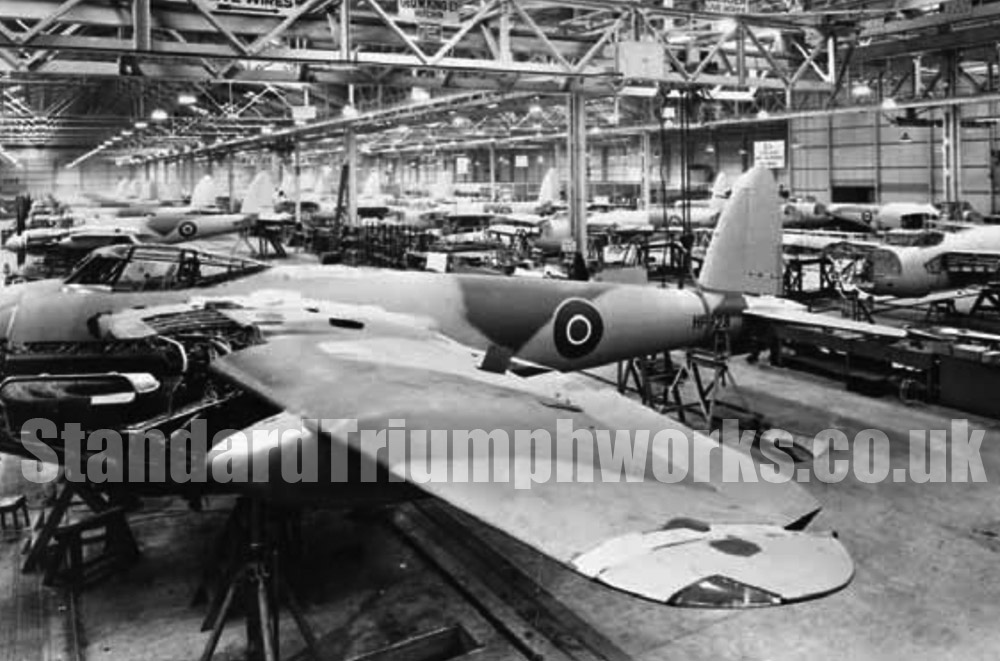
In addition, did you know that the Bristol Beaufighter was also built at Canley?
In the mid 50s as an apprentice, I used to hear one workshop being called The Carburettor shop; I eventually found out they were referring to the shop where the carburettors were made for the Rolls Royce Merlin engines which were also built there; I can remember seeing the little engine test houses being used as stores at the back of the factory at Banner Lane. A few were demolished to make way for a large new test-house for the Rolls Royce “Avon” jet engines, which were being produced at the Standard Motor Co. Fletch South factory. I believe these engines were mainly used in military aircraft such as the Hawker Hunter.
Details by Alan Whitmore
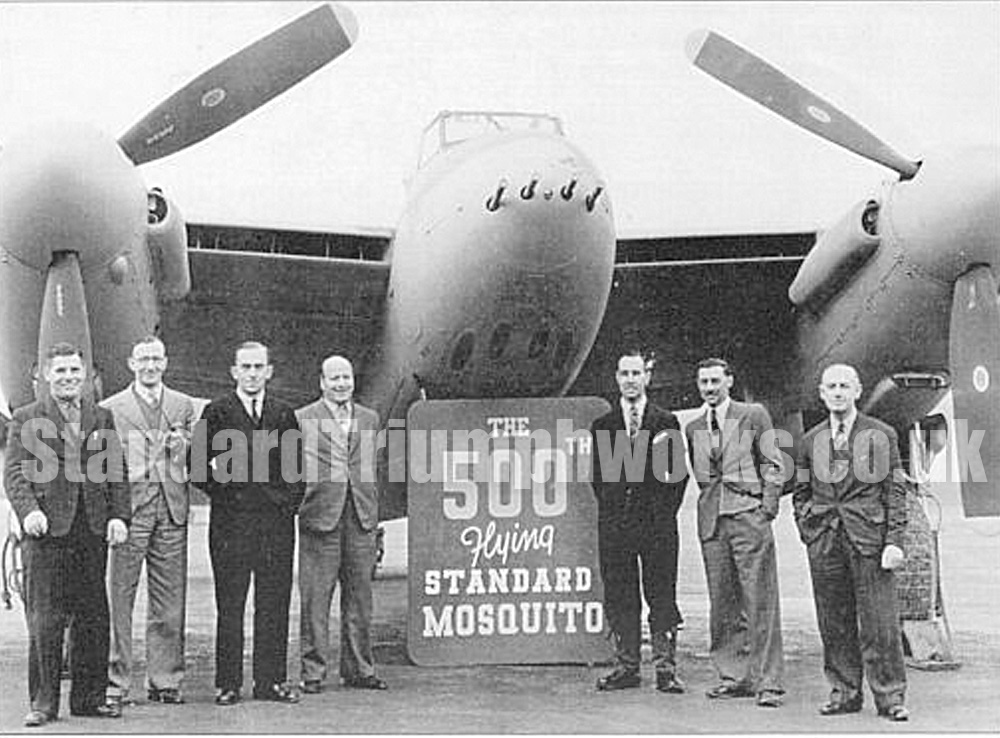
This particular photo has names for all the men shown.
L to R. Jim Thompson, Cecil Olorenshaw, Reg Addison, Charlie Newin, Bill Wanley, Bill Guessey and Frank Perkins.
The Standard Motor Company were producing a Mosquito fighter-bomber every day, using engines made at a “Shadow” factory, which it also ran. The Mosquito was made of wood. The furniture industry, mainly based at High Wycombe in Berkshire, machined all the parts. These were transported to Coventry and glued together at Canley to form the fuselage, tailplane and wings, which were then taken to Ansty on the eastern outskirts of Coventry to what had been a small airstrip for basic flying training of RAF pilots, assembled and test-flown.
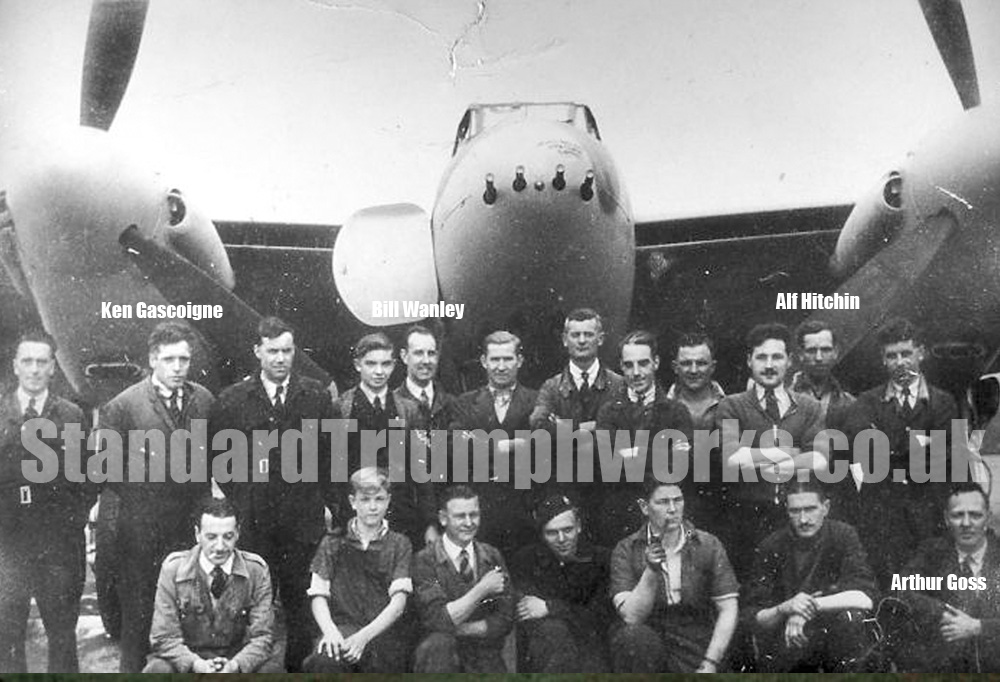
Back to the original photo and two further names have been submitted. Ken Gascoigne and Arthur Goss.
Harry Shaw, Fireman, Ansty.
P. V. Williams – Test Pilot, Ansty